Saturday, 13 June 2020

Drop ten, turn and Face.’ Quilty’s Football Yarns 8 Selling the game to the world

Drop ten, turn and Face.’ Quilty’s Football Yarns 8

Selling the game to the world
As a youngster I played three types of football. For Leeds in the University and Half Holiday League, for Old Parmiterians in the Southern Olympian / Southern Amateur League and for a whole variety of pub sides in the East London Sunday and Hackney & Leyton League both based predominantly at Hackney Marshes. It was for one of these Pub sides, The Brownswood Tavern, that I pushed my powers of persuasion to the limit. With Eleven O’Clock kick offs on a Sunday morning you are always introducing a random element for players in such sides. That is ‘getting so pissed on a Saturday night’ means that Sunday football starts very late! Anyway, this morning we had driven house to house throwing stones up at windows, chatted with mums on doorsteps and done what we could, to field a side. There were two crucial rules you had to comply with on a Sunday morning, First, you had to have at least seven players on the field at kick off and second, you had to start by 11.15am or forfeit the match. So there we were, 11.05am and just six players on the pitch. Desperate to play the game I did something questionable, but then I am persuasive around football. One of our regular supporters was a twenty year West Indian guy named Norman. He was there every week, hail or shine. Norman was also disabled, barely four foot tall and used crutches to stand up. Yes, I asked Norman to put a Brownswood shirt on and to walk two yards onto the field so we had seven players to start the match. Embarrassed, Norman reluctantly did what I asked, until five minutes later the cavalry arrived with six new players and he could come off again, might I add, to mighty applause from all at the ground. Looking back knowing my passion for the game I would still ask him today. Norman also quietly told me that that five minutes on the field sent adrenaline right through him, he loved it! Getting back to the Brownswood Pub later on, Norman’s story of his game role had grown to most of the first half. ‘Funny old game’ as Greavsey used to say😊⚽️


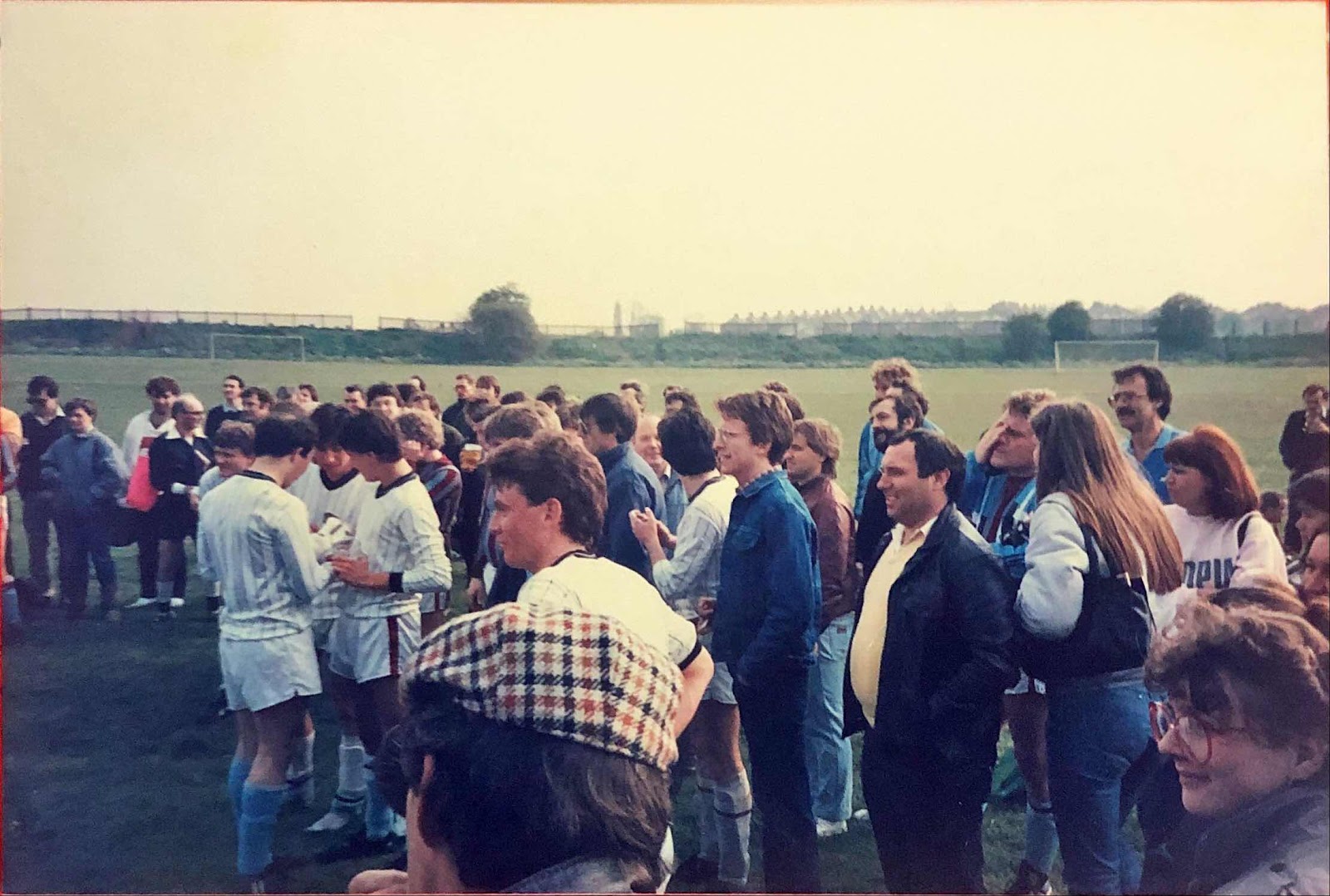
Greg Saunders a good mate. We played for the Brownswood Tavern together in the 80’s

‘Drop ten, turn and Face.’ Quilty’s Football Yarns 9 Away at University in Leeds: The Cold harsh North.

‘Drop ten, turn and Face.’ Quilty’s Football Yarns 9
Away at University in Leeds: 
The Cold harsh North. 

While I enjoyed my four years up at Leeds University playing twice a week, we did play in two distinct competitions. On Saturdays we travelled all across the north of England playing other Universities in the UAAC competition. Newcastle, Leicester, Manchester, Hull, Sheffield and Lancaster to name but a few. Midweek we played in what was quaintly called the Half Holliday League. Knottingley Miners, Leeds Post Office, St James Hospital and Leeds Asylum, at High Royds House, were some of the sides in this competition. This latter side were interesting if only because they played their home games in the magnificent Asylum grounds. As our coach drove in, residents could be seen in their pyjamas strolling around. One game we arrived to find ourselves a linesman short. The referee was an officious type and the game was delayed. Then, along the touchline one of the patients appeared, picked up the flag and stood ready to do the job. Quickly the captains approached the referee to chat. In a minute it was decided that this bloke would hopefully be as impartial as anyone and thankfully we got to play the game.
We had a fantastic ground out at Westwood but I never got on with the Groundsman, a gruff Yorkshireman. He once called our home matches off two weeks in a row when the pitches were playable. On the third week the pitch was under six inches of snow but he left the game on. The following week we turned up only to hear the game was off. Pissed off we put the nets up and played anyway. After 15 minutes he suddenly appeared in his car and drove on the pitch as we were playing. Scottish Brian reached the car before I did, insisting the groundsman wind down his car window. Not sure he understood every word but basically he told him, “Move your f’in car or we will roll it over”. He moved it.
As a follow up, by chance I was in the Student Union office one day. I wrote for Leeds Student and just happened be standing by the Union Administrators desk when I saw a file on his desk with my name on it! Full of 26 year old indignation I demanded an explanation. Apparently the groundsman had reported me! I got a full apology.
Being a team of University players in 1980 did not always go down well in the Half Holiday League, especially when we went to play against the coal mining sides like Knottingley. Set on a bleak snow swept hill off the M1, the pitch was decidedly more welcoming than the team itself. Being ignorant, I was convinced that the grunting right back who marked me was wearing eye liner. Only to be told that these guys only worked half a day on the Wednesday, before showering and coming straight to the game. The eye liner was in fact coal dust that had ingrained itself.
One of my last ever games up in Leeds was in 1983 and was the Cup Final of the Half Holliday League itself, we were playing a red hot Leeds Post Office side containing at least five West Indian super athletes in the team. Everything was set up right for disappointment. It was their home ground and they had hundreds of supporters out at Waddington Stadium. True to expectation they were running riot, just twelve minutes left and they were leading 5-2. We were shot. Then, one by one their superstars were withdrawn to a virtual standing ovation from the crowd. I personally came off the field at this point to be quietly replaced by a certain Paul Large, the son of Leicester player Frank Large. Paul had played a few earlier round games for us but insisted that we all enjoy our final and he would only come on if needed. Boy did we need him! First touch, Paul shoots and in off the cross bar, 5-3. Upon the restart Paul wins possession going the length of the field to score, 5-4. By now the Leeds Post Office crowd had ceased the celebration party and the subbed super-stars were demanding to be let back on again. Then just as time was running out Paul went wide, pulled the ball back for an easy tap in by a Leeds player, 5-5 and the end of normal time.
The unbelievable had happened and we went to extra time. With the momentum we had there was only to be one winner and sure enough Paul Large scored again to complete a most unlikely hat-trick and lift us the Cup. A great way to finish my four years in the cold harsh north!

‘Drop ten, turn and Face.’ Quilty’s Football Yarns 10 Schools coaching – London Cup

‘Drop ten, turn and Face.’ Quilty’s Football Yarns 10

Schools coaching – London Cup
I finished my degree and went on to get a PGCE teaching qualification in History and a Games qualification that allowed me to coach most sports, including Football, Rugby Union Volleyball and Basketball. Armed with this I returned to London and taught for a year at George Green School on the Isle of Dogs. Immediately I got engaged in school football and had the pleasure of working alongside West Ham scout Jimmy Firrell. Fortunately, after a year of working as a Supply Teacher I picked a permanent job at St Bernard’s in Bethnal Green. This was a split site school with one building on Old Bethnal Green Road and the other on Valance Road, familial home of the Kray twins. A lot of people believe that facilities make a school. Untrue. Comparing George Green and St Bernard’s the former had way superior modern buildings but less than half the school spirit of the latter. Our buildings in Valance Road were set in a small space with no grass in sight. Games were played in a restricted playground but the kids made the most of what they had. It was a surprise that when I offered to take the U17 Football side, everyone in the administration got very interested. They wanted to know how often I would take them after school and for how long. To my further surprise they actually said I’d be getting paid a decent amount for doing it. The school was on ILEA’s register of underprivileged schools and there was funding available to promote extra-curricular activity. I later found out that they would have paid me to take any group after school be it tiddlywinks or chess, as long as I’d put in the necessary paperwork. Little did I realise but I was about to embark on one of the greatest coaching experiences of my life.


 In the London School area in the eighties, there were various age group versions of the ‘London Cup’ ranging from U11 –U17. We were entered into the senior age group, the Lipton Shield. Here began a crazy ‘under the radar’ campaign where we won six matches in extraordinary circumstances. On at least three occasions we came back from two goals down to win. We played all our games ‘away’ because we had no pitch of our own. Some of the school’s we played were real heavyweights on the school scene. Probably most surprising of all, the St Bernard’s school management were seemingly unaware of our exploits, only a select few parents and supporters came along but here we were beating the best sides in London! On the way we played Hackney Free & Parochial at the Marshes, St Bonaventure's at Newham, Sir George Monoux out at Walthamstow, went west to Carshalton, east to play Dagenham Priory and a City School in Central Foundation, before taking on Lambeth heavy-weights Sir Henry Thornton, when, against all the odds we reached the final. The Cup organisers contacted me and said they were unsure who should host the final. My response was to say we had had six away games so we should host the game, which admittedly, was difficult with no home ground! Fortunately, I had a contact on Tower Hamlets Council and with a bit of persuasion managed to get East London Stadium to host the game for us, we were after all an East London side.


 In the Lipton Shield, London Cup Final we would meet Sir Henry Thornton of Lambeth. They were previous Champions in the competition, a tall side and boasted several players who would eventually go to play professionally, the most famous being big striker Kevin Campbell of Arsenal and Everton. On the day we were under extreme pressure. After 20 minutes we had a chance of our own only to see the Lambeth side break away and get the first goal. Going in at half time 0-1 would have been manageable but right on the whistle we conceded from a corner. In the second half St Bernard’s boys really stepped up and with ten to go we managed to pull a goal back to make it, 1-2. Then as we pressed for an equaliser they broke away to score a third and seal the win. What an effort, runners up in a London wide competition of over 120 schools. The boys collected their Runners-up medals in front of the East London Stadium crowd. Most of our support had bunked off school to come along! This wonderful effort unfortunately hardly registered on the airwaves of our own School, only a full match report in the Local newspaper awoke people to our achievement. That was a salutary lesson for me as a coach. You can only set your own standards and goals. Don’t rely on others sharing your passion but make share you are your own side’s best and biggest advocate.
Round Opponent Score
1 Hackney Free & Parochial 3-2
2 Central Foundation 4-2
3 St Bonaventure’s 5-3
4 Dagenham Priory 4-0
5 Carshalton School 2-1
Semi George Monoux 3-2
Final Sir Henry Thornton 1-3

Drop ten, turn and Face.’ Quilty’s Football Yarns 11

Drop ten, turn and Face.’ Quilty’s Football Yarns 11
One of the sadder things that occurred while I was working in schools football was a ‘teachers strike’ of about twelve weeks that absolutely decimated the competition. Not that the industrial action wasn’t justified but it just happened to have a devastating impact on the Saturday Schools Football competition. At that time teachers weren’t paid to coach but everyone relied on their goodwill to do so. Unfortunately, telling kids that there were no games for three months meant that they literally found other things to do. East London School’s football was never the same again after that.

St Pauls Way and Warwick Boys School
In 1990 I lost my job working on the Stock Market in London but was fortunate enough to have my previous career of teaching to fall back on. Old friend and teacher Martin Rabenau got me back working pretty quickly, out at St Paul’s Way, Bow. This school had a population of mainly Bangladeshi kids who loved football but it was always difficult to get them organised to play school matches. One big problem that the local education authorities brought upon the school was inadvertently done. Most of our kids came from Muslim families. When the Somali Civil war resulted in a few thousand refugees coming to East London, St Paul’s Way was identified as a suitable place to send the children involved as they shared a common religion, Islam. Unfortunately, the new comers lacked language support and quickly clashes between the two groups broke out. Many of our Somali kids had recently been child soldiers in the conflict and few were used to the discipline of lessons and attending school at a particular time. A few kids had ‘war wounds’ from the conflict. Things escalated because a lack of cultural insight underestimated the degree of vendetta and grudge the group possessed. A scuffle at school, seemingly resolved would usually return ‘out of the blue’ the following day, the parents had discussed matters with the children but they tended to come in with renewed anger prompted by parents! Eventually, resources were brought to play and the clashes reduced. However, that was not before ‘scummy Sun news-hounds’ came trolling around the school seeking gossip.
When I eventually got another permanent job it was out at Warwick School Boys, Walthamstow in the Waltham Forest district. This was in late 1991. I was running around desperately dropping off my CV to local schools, we actually lived at Highams Park at the time. Warwick School Boys was five minutes from my house. Going into the busy school foyer I had planned to be in and out quickly. It was to my surprise then, as I handed my CV envelope across the counter, a tall gentleman took it but engaged me in conversation by grasping my arm. I had no idea who he was but quickly told him my ‘casual teacher story’. It was then he told me he was the school Headmaster, I had passed my interview and was I okay to start on Monday morning? Amazingly random story but it provided me with a permanent job just five minutes from home! At Warwick I taught History and PE. The school was Church of England but reflective of change in the area,our students were 80% Pakistani in origin. As usual I organised the football team and was in my element. We made the local district semi-final going down to local rivals Norlington. Again, we never actually had our own field so spent hours taking lessons on the playground tarmac, occasionally going to Wadham Lodge for a Games afternoon. Down at the Lodge we had ex-footballer twins Bill and Ben King putting on football sessions.  It was during my time at Warwick that we decided to immigrate to Australia. It all came about very quickly. The Headmaster was devastated. He asked me to help find my replacement. Fortunately, I had very recently got an old school mate Steve Tuvey to come in to take Squash and Football lessons, he was a qualified coach of both in addition to being a carpenter. When I suggested that Steve take over my role it all fell into place. The students knew him. He looked the part of a PE teacher and could control the kids. The only small problem was that was not a teacher! The kids even believed that Steve was my brother (in spite of having the same first name!). The Headmaster asked Steve if he was willing to train on the job, to enhance his one O Level and to this he agreed. In the event Steve worked at Warwick for 15 years! He became Head of Year 9 and also taught PE and Woodwork. In all seriousness I don’t think I have ever met a more natural School teacher than my friend and replacement Steve Tuvey. Confident of his ability to take my job at Warwick, my family and myself now moved on to start a new life in Australia on March 17th 1992. Steve only retired from his teaching job this year after 28 years moving to Devon.

‘Drop ten, turn and Face.’ Quilty’s Football Yarns 12 Australia

‘Drop ten, turn and Face.’ Quilty’s Football Yarns 12 
Australia
Leaving London to move to Sydney was the biggest decision of our married lives, we never regretted it for a minute.
Immigrant stories are many. Ours, while not spectacular certainly has a few constants and reoccurring themes within it. It also seems to echo much of the received knowledge of what migrants do when they arrive in a new place. Perhaps the most regular theme  is our association with Berowra and in particular the area around the old La Mancha Caravan Park. It is often said that  migrants tend to settle very close the original place where they arrive in the country. In our case the point is very relevant because we now live just 200 metres, as the crow flies, from the very first place we started out in Australia twenty eight years ago!
I was allowed and qualified to teach in Australia but had to find the work myself. The economy, like that in the UK was actually still in recession with the jobs market very slow. For a few weeks I supplemented our income working for John at weekends in his catering business, ‘Cassidy’s Catering Company”. 
What John, Terrie’s brother suggested was that rather than rent a house when we arrived, it would be more sensible to take a twelve week contract on a local caravan park while we got an idea of what and where we wanted to  settle. This would help us avoid locking ourselves in for a year somewhere we might not like. At the time there were three main options in terms of caravan parks. One up in Ryde which was the closest to urban Sydney, a second up on Mona Vale Road, relatively close to the northern beaches and a third up in the north at Berowra which was surrounded by bush. As it turned out John chose the third option for us and we started off at La Mancha Caravan Park, just as you come along the Pacific Highway and enter Berowra. This choice made by John unwittingly shaped our future life and direction in Australia. Largely because I'm sure that urban Ryde would have been closest in lifestyle to central London where we came from, while Mona Vale would have directed us down the 'beach lifestyle' route.  Berowra, surrounded, by bush was much more like living in the 'country' to us Londoners.
The night we arrived in Australia I still remember being driven by John up along the dark Pacific Highway along the sweeping road that eventually enters Berowra....La Mancha is immediately at the top of the hill on the left. The sizeable site actually being at one of the highest points in Sydney perched, surrounded by and overlooking large tracts of bushland. When we arrived on the evening of 18th March 1992 we were met and shown by the site owners to a small cabin with a double bed, a set of bunk beds and a small kitchen / dining area. I also clearly remember that evening standing with Terrie looking out over the Berowra valley with houses below and an unfamiliar star filled sky. Immediate thoughts were. 'what have we done?' Here we were, in an unknown place with two young children and we had no jobs! With Cassie just 18 months and Danny 3 we settled very quickly into our small chalet.
The site did have a small store but we tended to walk down along the highway to the Shell petrol garage because it had a wider range of supplies. Fatefully it was in this place that in the first week since our arrival I saw a small note displayed advertising 'Over 30's football players wanted'....come to Berowra Oval.....Well it is certainly true that finding familiar things / activities helps people settle in new places and this was an opportunity to do just that. It is true to say our time in Australia was shaped in many ways by going to the oval that night and meeting up with other prospective Over 30's footballers. In the event I met three Englishmen, Colin Strang and brothers John and Jimmy Everitt. These guys remain some of our closest friends even now in 2020! For me it was a sport connection but also important for Terrie in making initial friends in Berowra and later securing several of her first jobs. There she was stuck on the caravan park with two youngsters on what emerged as one of the wettest months Sydney had seen in years. Colin's wife Bernie is part of a large Dublin family of which six of the brothers and sisters lived in the area. In that first week Bernie invited Terrie and the kids on a barbeque with other Berowra people including another Englishman Paul Squires. Paul was to give Terrie her first job. This external relief of meeting other families was great for an immigrant couple with few Australian contacts. Eight percent of Berowra residents are originally from Britain /Ireland and we fell right into the ex-pat network in the town. 
La Mancha was a safe place to start our immigrant life but although I had been accepted as a High School teacher the actual work had to be found by myself. In the first few days I took the scatter gun approach to job applications...not really knowing where the schools were in NSW just sending out as many CV's as possible. I even phoned Education Office’s in Western Australia and the ACT but they just told me I was better off in NSW. In addition I went in person to schools in Sydney to hand in resumes. One in particular was to play a large part later in my life. It was a Catholic school in Chatswood which had the seemingly strange name of St PLUS! At the time I just thought it was some particular Australian Saints name....not realising I had misread it from the actual St Pius X (where I have now worked for 23 years!) Waiting for approval for State schools actually took me many months. We would have starved waiting! Fortunately I'd  previously worked in Catholic schools and they sorted out my paperwork in just three hours!
Initially, it was my task each morning to go down to the solitary Caravan park call box to phone some local schools to seek casual work on a day to day basis. I'm not sure why, but a particular Deputy out at Mater Maria College Warriewood must have taken pity on me. One rainy day at 8.00am he said to me "How quickly can you get here?" I plucked 30 minutes from somewhere in my head and promised to be there in no time. Well Warriewood is at least 45 minutes from Berowra and I drove (what turned out to be a very iffy Mazda) in driving rain to get there. The School Deputy, Andy Martin was a gruff northerner who must have somehow recognised desperation in my voice. He brought me in to help minimize a potential disaster at Mater Maria....it was the day of their School fete, many staff were away and it was pelting with rain. Andy placed me in charge of 30 odd year 12 students and just asked me to keep them out of trouble as the rainy day threatened to descend into soggy farce.
I worked there for three months before eventually securing a seven month contract at Our Lady of Mercy College, Epping. As a new immigrant you are certainly very aware, if not actually desperate, for the need to work. While doing casual days before my contract at Epping I got the chance to interview for a job at a Primary School in Merrylands. No, I’m not Primary trained but in times of recession I certainly wanted to secure a job. As things turned out they seemed willing to hire me teaching predominantly PE to the juniors at the school. It was between myself and one other person. Then just as  I left the interview they told me that a high point of my week would be at the School Assembly on a Friday morning, leading the dance called the ‘Fitness Hustle’ for 400 students! Not really knowing what to say, I nodded and said I would await their call the next day. My wife Terrie was amazed that I had put myself in such a position. Knowing how uncoordinated I was in all things requiring rhythm!
Next day I returned for another casual day at Our Lady of Mercy College, Epping. Then one of those key life moments occurred. The Head Mistress, Jan Gallan and another teacher approached me. The conversation went like this.
“Mr Quilty, we had something we wanted to ask you but were unsure. Would you be open to taking on a seven month contract here at the college? I hope you don’t mind us asking?”
For what seemed like a minute I stood there stunned. Then a feeling of overwhelming relief swept over me and I launched forward to hug them both.
“You have just saved my life, you have just saved my life!’
Later on I went on to explain what I had almost agreed to out at Merrylands, I think they understood. At recess I was able to make a phone call of regret to the Primary School.
As is the way, like with this job at Epping, my next job also came about in a random way. One day near the end of 1992 someone brought in a tiny advert from the Sydney Morning Herald. Clearly a guardian angel was looking out for me because this role teaching Business Economics and PD Health was seemingly made for me. I phoned the advertised number and the person who answered, Robyn Meadows, must have felt sorry for me and my English accent. She quickly told me that I would be one of just four people interviewed the coming day and that there had been over 100 applicants! Robyn explained that I would be seeing two people. Michael Carr the Headmaster, and John Decourcy the Deputy. She even primed me for interview saying. “Michael who runs the College Rugby League side will be very interested in your football coaching ability. John, on the other hand will just ask you some offbeat educational theory questions, good luck with that!” As things turned out, that was exactly the way the interview went. My major contribution to the interview being that “With this mix of subjects whoever you get will be a bit of a compromise”. That got me the job to start end January 1993.

‘Drop ten, turn and Face.’ Quilty’s Football Yarns 13 Coaching in OZ – The beginning 1993-4

‘Drop ten, turn and Face.’ Quilty’s Football Yarns 13

Coaching in OZ – The beginning
1993-4
Living in Berowra but working in Blacktown was a logistical challenge. A journey of exactly 40km either way. When I first started at the school the M2 had not been constructed so I needed to scan across country to get there. Fortunately, it was a journey against the traffic usually taking 50 minutes either way. Being firmly in the west of Sydney, Blacktown had an average temperature 2-3 degrees above where we lived. Add to that the inconvenience of driving an old Mazda lacking air-conditioning and often I’d require a change of clothes arriving at work. John Paul II Senior School had co-ed 1150 students and about 100 staff. It was a good school that truly practiced what it preached. Students were able to achieve in a number of ways, be it Performing Arts through Rock Eisteddfod, Sport or Academia, the college had it covered.
When I arrived at JPII the Headmaster, Michael Carr, explained that it was school that was currently performing very well in Rugby League but had not got towards its potential with Football. Being a large Catholic school it had a broad ethnic make-up, Anglos, Italians, Croats, Philippino’s and Maltese all being well represented.
The school was involved in probably the strongest schools competition in the country, the ten team ‘Metropolitan Catholic School’s’ league, the MCS. Some truly heavy weight schools took part predominantly form the west and south west of Sydney. Eastwood, Fairfield, Parramatta, Emu Plains, Greystanes, Campbelltown, Ryde, Dundas and Auburn made up the draw. It was a Thursday afternoon competition of nine round matches before semi-finals and finals for the top four. Each school had an A & B Grade side kick off times being 1 O’clock and 3 O’clock. This play off finals format was something completely new to me, not being the way in the UK, where if you came top of the competition you won the league.
At my first training session I was accompanied by Di Kosak, one of the college office staff. She had a big local involvement in Football, knew the players, which schools they had come from and more importantly which clubs they were involved with in addition to JPII.
About eighty players turned up that first session trilling for 32 places in the A & B Grade squads. I had never experienced such a turn out but made a good early call when I said that the trials would take place across three sessions.
At my job interview Michael Carr had told me what a strong, skilful competition the MCS was. His Rugby League boys played in a parallel version of ours. The main difference being that theirs was probably more prestigious and the games were often shown on Television, especially in the Nationwide Commonwealth Bank Cup. He threw a tough question at me saying, “I am aware that potentially we have a very skilful side, what will you do to make us winners of the MCS?”
My answer was a good one. I said, “You telling me that the whole competition is strong and skilful. I will just have to get our sides working harder and become fitter than all the rest in the competition. That was exactly what I did.
In my first season coaching at the school in 1993 we won seven of nine A Grade games with just one draw and a defeat in the regular season, finishing in number one spot. Many of our boys were also playing for good club representative teams that included Marconi, Sydney United and Sydney Olympic. While this was good it also made claims on the player’s time so that our training was restricted to an hour on Monday afternoon. A good choice because that was also the day for JPII after school staff meetings. From the beginning I had the bosses blessing to be absent. He said, “It’s not as if you are down the pub. You are on School business taking the boys training”. Michael also appreciated the 80km round trip I made to JPII each day.
Our B Grade side managed to make the play offs in 1993 with a fourth place finish. Our only A Grade defeat was early on out at St Gregory’s Campbelltown. A bit of an ambush on a small pitch. However, that was an invaluable lesson because it was the side we would eventually win through to play out at Melita Stadium, Granville, in the MCS A Grade final. That A Grade side was predominantly Year 12 boys with only two Year 11’. This made us very experienced and strong. As said previously, all the sides in the MCS were skilful, I just insisted that we continually got back ‘goal-side’, not something all players liked or appreciated. One player, Tony Messina tended to jog trot his recoveries, often walking. In this particular game I shouted to him. “Tony are you injured?” “No sir, why is that?”. “Ok mate, off you come!”. Tony was flabbergasted, he’d never been withdrawn from the field before. Another good lesson. Every time following that game I’d only have to shout “Tony” and he’d immediately start to run and work back.
Working around the world, in the UK, Israel and the USA had fully exposed me to interaction with a whole mix of creeds and ethnicities. Working out at Blacktown was to be no different other than to throw in a few new ones. Italians, Greeks, Maltese, Lebanese and Croatians to name a few. Fortunately we were all speaking the same language, the language of the world game, football. In this 1993 A Grade side there were several of the best players I had ever worked with. One, Daniel Matan was a two footed central midfielder able to surge at pace making rapid inroads into opposition defences. As we went through the season a small irritation with him emerged, mainly because his dad, always there in support,  would stand by the fence and shout out instructions. I’d never had a problem with that but in this case the instructions were in Croat! I felt that this was potentially undermining, so I had to address it, telling his dad that input was fine but it had to be in English. As explained Daniel was a fine player. He was playing for the Sydney United U18 side at 16. Unfortunately, at many of the NPL clubs, politics played a big role. Daniel’s dad just happened to fall out with club football committee and his son Daniel had to leave the club. This 1993 season ended up being one where we almost swept the board. We won both the MCS A & B Grade finals but should also have won the NSWCCC Cup Final, losing in the semi-final. In the event, the eventual winners Fairfield, were a side we had beaten in Round One 4-0! Somehow, they were allowed back in to the competition when someone forfeited and ended up beating us 2-1 in the semi-final. The competition convenor had made a call to benefit the knock out, we just happened to come off worse for it. In the following seasons I actually became the convenor of the NSWCCC Cup and myself almost paid a big price for trying to be fair to the sides and players involved. In this case I got a call from a school coach form Casula, who told me one of his players had been unfairly red carded in a game. Hating the possibility of a player being unfairly treated and possibly missing out on a final, I called the opposition coach for confirmation. In a sporting spirit that coach concurred, saying that the red card was wrong. With this in mind I took the decision to rescind the card, freeing him up for the next round. Jump forward several cup rounds to the semi-final stage and I get a call from Oakhill College telling me that their player, Tony Mitiga had been unfairly dismissed and was down to miss the final. Looking at their potential opponents Casula, I realised that this was the team whose player I had re-instated. Making a quick call to their coach I explained the red card situation for Mitiga and also reminded him of the benefit they had got with the earlier rescinded red card. To his credit the coach quickly agreed to let the player play in the final. I personally felt a kind of satisfaction that two players had now got to play in possibly the biggest school match of their lives. That was of course until Mitiga scored a very early goal in the final! Fortunately Casula came back to win but you see how it could have been a bit awkward.
As an Englishman in Western Sydney I was up for taking any coaching opportunities that arose. One such opportunity was to be involved with the MCS and ultimately the NSWCCC Representative teams. Those I worked alongside were great, passionate servants of the game but I almost fell out with one administrator when the Trials were being held down at Cronulla. We had played the selection tournament and were now wrapping up before announcing a sixteen player squad that had been picked. I offered to go around to take the nets down and pack up ready for us to make the long journey home.
It was a surprise then, that when I returned ten minutes later, one of the squad names had mysteriously changed with a player associated with the administrator being substituted in! After my initial shock I had to say something. The squad was about to be announced but I didn’t care. Taking him aside I said that if this was going to be the way the association ran, I wanted nothing to do with it. His immediate suggestion was to put the player back in and run 17 not 16. I agreed but had had an insight into the politics of School Rep football.
While that 1993 season of success at JPII was brilliant, it was the beginning of an amazing run of success in MCS finals all played out at Melita Stadium, Granville. It was a bit of a shock then when our 1994 side bombed out of the finals series in both grades. Di Kozak had stepped down from the manager’s role to be replaced by fellow teacher Tina Tasioulas. Having virtually a whole new squad we certainly had good players but never quite got it together. It was just as well then that some of the female students came forward and suggested that we form a JPII U18 women’s side to enter the new MCCS competition in 1994. Karen Portelli, the sister of our 1993 centre forward, Robbie Portelli led the way along with Kelly O’Neill another of our Year 12 students. Both had played good club football in the Blacktown area. This was personally my first experience of coaching a women’s side. How would I approach it? There was only one way and that was exactly the same as with the men’s sides. In the event this always proved a good move for me across my 15 seasons involved with women’s sides. Terrie always laughs out loud when I roll out a very serious but heart felt personal expression. When asked about men’s and women’s football I always say, ‘’I don’t see gender when it comes to football, I just see players”. Corny as it sounds that is exactly how I will see it. My passion and commitment to football is a constant regardless of the side I am coaching. I have always believed that it is an aspect of leadership. Players and by association, their parents, appreciate that I take it seriously.
To get together a squad for our girls U18 side, we did it exactly the same way as with the boys, we held a series of afternoon trials for anyone interested. One thing I learnt quite early in football was that if someone is an achiever in one sport at a high level, they will often be able to adapt well to football. There were several cases in point with this side. Kelly O’Neill introduced me to Lyneene Clarke who currently played softball for Australia. Lyneene Clarke was 5ft 10in and looked a strong individual. In the conversation that followed I said that I was about to type-cast her and make her a centre back. When she said I don’t know what a centre back does, I said don’t worry we will teach you! Another potential player was Marijana Almasi who was a fine State ranked gymnast. We also had a two girls who were dancers and another Elizabeth Migdalski who was a boxer. The position we always struggled to fill was goalkeeper. At JPII we fortunately developed such a dominant side we got away with it. In 1994, the MCCS competition consisted of eight sides. Conveniently, all the games were played at the same venue out at Auburn. The hosts, St Leo’s, Wakeley, Emu Plains, Mercy Parramatta, Westmead, Greystanes and ourselves made up the eight. Only losing a single game in the competition we beat St Leo’s in the semi-final before meeting Wakeley in the final. As it transpired we turned up at Auburn only to find that the pitches were in poor condition and nearly waterlogged. On the day I was confident but immediately sensed that our girls were starting to psyche themselves out. They had seen a giant muddy puddle in the middle of the pitch and didn’t fancy getting their white kit dirty. Rightly or wrongly I made a decision. Abandoning the redundant warm up, I took our girls to the centre circle. Facing into the muddy centre I announced that everyone would kneel down in the puddles and splash their kit with water to get used to the conditions. Reluctantly the squad did just that and I told them I felt that this would be to our joint benefit. No sooner had they all stood back up covered in muddy water than the competition organiser appeared to announce, “No, no, you aren’t playing on that terrible pitch, it is a Grand Final you are over there on the main field!
Fortunately, we were right on kick off and no player had a chance to get to me, to say exactly what they thought. Of course the mud strategy worked because we absolutely demolished the opposition 4-0 and all was forgiven. We were inaugural MCCS Champions, a title we would also win for the next two seasons 95’ and 96’.
‘Drop ten, turn and Face.’ Quilty’s Football Yarns 14 1995 Sweeping all. (Old video added at end)

‘Drop ten, turn and Face.’ Quilty’s Football Yarns 14
1995 Sweeping all. (Old video added at end)
Probably don’t acknowledge it enough but I feel I have been truly privileged to work the sides I have coached over the years, in all grades of football. That also goes for the fantastic fellow coaches who I have stood alongside over those years.
When season 1995 rolled around it was a truly purple patch for John Paul II School. The School made the State wide ‘Schools Rock Eisteddfod’ final ably coached by past masters Henry and Christine Taylor. They'd previously won the whole thing back in 88'. In addition. Principal Michael Carr’s ‘masterplan for Rugby League’ was coming to fruition. They were already dominating the very strong MCS competition and were now making their run at the nationally televised Commonwealth Bank Cup. The school, through Michael, had established a very close relationship with two NRL sides, Penrith and Parramatta. An illustration of this connection was demonstrated to me one day when the ‘Super League War’ broke out’. This was a truly massive sporting story around Australia so I was very surprised to be standing next the school fax machine when the following message came through.

Dear Michael Carr
I am writing to ask you, in your capacity as Head of MCS and NSWCCC Rugby League, to align your organisations with Super League in Australia.
This was a massive story but it showed just how important schools, such as JPII, were in the Rugby League player production line to the National Competition.
Over the years we also had seeming direct line to many of the best schoolboy prospects out of New Zealand and the Islands. When coming to the school these players were helped with accommodation and their school fees through sponsorship. Coach Bill Dowers, assisted by Michael Carr, had established a strong record locally and the side were now striving to become National Schoolboy Champions. So serious was this intention that the school managed to secure land to build a field for the team. This was located half way between JPII and our feeder school Holy Family. In 1994 JPII duly won the Commonwealth Bank Cup in a commercially televised game defeating Eagle Vale in the final, repeating the effort again in 96’ v Erindale College Canberra. With JPII having secured two major events in the year, it was now footballs turn to deliver.
Learning from our disappointment of season 94’ we were much better placed in 95’ to win the MCS competition, as things turned out we’d go beyond that and advance all the way in the NSWCCC cup competition as well.
Our 95’ squad was very well balanced. While we had super stars such as Michael Pfeifer and Michael Cunico we also had a deep vein of talent across the squad. As mentioned earlier we had many players who had played other sports at a high Level. Grant Lambert played cricket for NSW and Australia, Stephen Falls was both a good athlete and fine rugby player, Craig Beacroft was a state level touch footballer and race walker, Justin Waring went on to be a professional golfer while every player other played football at representative club level. Our Captain Adam Scarpin made the NSW Football side only being surpassed by Cunico who played for Australia U15 and U17 in the World Cup.
The MCS Competition, as ever, would be tough. In 95’ we also had a top B Grade side who went on to win their Grand Final, many of that squad would have been A Grade players for almost any other school in the competition. They did it the hard way finishing fourth and then winning their semi-final on penalties against Minor Premiers Holy Cross Ryde. In the final they beat Dundas, a side they had lost to 4-1 in the first round game. Captain John Longhurst proudly lifting the Trophy.
Our run to win the NSWCCC Cup was truly epic, going from early in Term one until late in Term three. Our first round 5-1 win over De La Salle Cronulla was quickly followed by a come from behind 2-1 win against Casula. Playing on a very wet Holy Family field we then took on Oakhill College from Castle Hill. This tie was a cup classic. We led 1-0 with just a minute to go only to concede on the final whistle. Things got worse when with just five minutes to go in extra time we trailed 2-1. A brilliant finish by midfielder Michael Pfeifer pulled us level for what seemed a certain penalty shoot-out. However, our Captain and sweeper Adam Scarpin had other ideas. With minimal fuss he signalled to the coaching staff that he was ‘moving up’. Within a minute he’d picked the ball up on half way and literally went right through the middle beating numerous opponents to calmly finish, we were in the next round.
Our fourth round opponents were old rivals Parramatta Marist and surprisingly we allowed ourselves to be ambushed. On the afternoon in question we changed our routine and allowed half our team to make their own way to the ground. Mistake. A big mistake. These players arrived right on kick off. In the meantime, Parramatta had cancelled all training for the afternoon and had a massive cheer squad there for their boys. Predictably, we conceded in the first minute. Alarmingly we conceded again two minutes later and then in the twelfth minute we were 0-3 down and heading out of the cup. Somehow we filtered our late arriving players into the game and held on until half time when we could actually talk to the team and put things right. Our message in this case was twofold. For our team we had 40 minutes, starting at 0-0 to pull this around. For Parramatta, we told the boys that we would gamble that they wouldn’t know whether to ‘stick or twist’. It turned out to be a winning approach because as soon as we scored one goal the opponents just fell apart. Their big crowd went very quiet as the minutes past. A 3-1 score-line soon became 3-2 and then with ten minutes left, we won and converted a penalty for 3-3. Our momentum was such that we scored again for 4-3 with just five minutes to go. Our amazing turnaround was complete. This NSWCCC fourth round win was big wake-up call. For the second game in a row we had come within minutes of defeat. That afternoon the squad pledged to do all we could to go on to win it.
The rules of the NSWCCC cup are such that at the Quarter Final stage the ‘City schools have to go Country. Our next round opponent was St Johns, Kempsey, a six hour drive north from Sydney. Our Headmaster Michael Carr insisted that we would drive up on the Sunday, play Monday and drive back the same day. Normally this would have been fine for me but on this weekend I actually had visitors over from the UK. A compromise was made. The team would drive up in the mini bus Sunday morning while Michael Carr paid for me to fly up that afternoon. Sorted! That night our squad stayed in apartment’s just outside Kempsey. The plan was to drive in next day, play at midday and drive back to Sydney after the game. Wrong! The Headmaster of St John’s made us wait until 3.30 when he brought out the whole school to watch the game. In the warm up we were still pretty confident, we had our full squad and they looked a pretty basic side. It was then that we met the ‘local country referee’. Pulling our side together for the boot inspection, he clearly liked very little about the way our boys looked. As mentioned previously, we had a very culturally diverse side. The referee didn’t like our hair, the headbands or product in the hair. He clearly disliked our kit, especially the long baggy shorts and colourful boots worn by all. By the time the match began we saw that this would be more of a contest than we realised, especially with an official who seemingly disliked everything about us! The match was brutal. He allowed St Johns to kick three shades of shit out of our boys and with ten minutes left at 0-0, I made a big decision. I took off the two Michael’s, Cunico and Pfeffier. Most of our group didn’t believe it, they were our two stars. As both a teacher and coach I felt I had a ‘duty of care’ to these players. They would either get sent off or carried off and I wasn’t willing to see either happen. Then, just when extra time seemed certain, our main forward Jason Vella hooked the ball home at the near post and we won the game 1-0. Offers of ‘afternoon tea’ at the school were declined as we left Kempsey in a cloud of dust and headed home to Sydney, relieved but more than that, in the Semi-final of the NSWCCC cup!
As mentioned earlier during my four years at JPII I was fortunate enough to be involved with the NSWCCC representative teams. These guys competed every year in the All Schools tournament which ultimately picked the NSW Schoolboys side. During my involvement numerous players we coached advanced to both the Australian Joeys and Schoolboy sides. In tournament itself there were two NSWCHS sides and one from the independent sector the NSWCIS. The commitment for players was considerable because many boys also played Representative club football at places like Marconi, Sydney United and Sydney Olympic. I remember around the time of our great cup run I was also preparing the NSWCCC side. Players came from all over Sydney and country NSW. This was just one illustration of the tyranny of distance in Australia. In my experience at trials the country boys had to be better to be picked. Just equal and the city boy tended to get the nod. The major reason for this being that with training commitments, it was difficult for the boys to get there midweek. To me both School and Club representative football were as much a test of parents as it was the players. In 1995 I remember a training session was switched from Bankstown to Blacktown quite late. The player parents had to be informed. A phone call with the mum of Clayton Zane expressed this test quite clearly. I told her of the switch and she said it wasn’t a problem because they were coming down from Newcastle anyway. It made me think. What about those players along the way who just couldn’t get there for whatever reason? Lack of transport, cash for travel or even being unable to afford the fees that accompanied representative football. In the event Clayton Zane went on to play for Australia and NSL side Northern Spirit. He has also made a career for himself in coaching at Newcastle Jets. Our paths crossed several times in 1995 because not only was Zane in the NSWCCC side but also a player for JPII’s semi-final opponents St Xavier College Hamilton.
Now this was a big game for all concerned. We were down to the best four Catholic sides in NSW. It was no surprise then that I was angry that the game was not only to be on a school day afternoon but we would have very little in the way of student support. Up until now all our big MCS Finals were night games, with considerable crowd support. The late Dougie Schultz, the JPII Sports Master managed to calm me down before I clashed with the school executive. I suppose this was one of those examples where the relative inequity between Football and League was coming out. I sensed that they would have been better accommodated. From this time I actually began to frame my own coaching and sporting philosophy. I said to the boys very clearly, ‘Don’t worry about other teams and sports. We need to set our own goals and standards’. Driving out to Valentine Park to play St Xavier’s our boys were very motivated. A squad of 16, manager Chris Wilson and myself. That was it apart from a few odd parents. Really we should not have worried. We absolutely demolished Clayton and his Newcastle based side. The score was 5-0 and it might have been more. We were through to NSWCCC cup final and would face Christian Brothers Lewisham from the MCC competition, out at Melita Stadium.
Having had such a great cup run and also winning both the MCS A & B grade Grand Finals made us favourites to also lift the cup. It was a massive blow then, that before the final it was announced that Michael Cunico had accepted a place at the prestigious AIS in Canberra. He would be unavailable to play in the final! If that wasn’t enough Michael Pffeifer accepted a job and was on the brink of leaving school as well. In the event the school refused to ‘sign him out’ until after the final which meant he remained a student at JPII long enough to play in the final!
One coincidence around this final was that the coach of that Lewisham side Maranko, many years later came to work alongside me at SPX. Something similar also happened when we defeated Ryde in an MCS final and then a few years later the coach of that side Craig Sharply turned up as coach of the St Joseph’s Hunters Hill side in a NSWCIS Final.
Christian Brothers Lewisham came from our sister competition the Metropolitan Catholic Colleges (MCC) ours being the Metropolitan Catholic Schools (MCS). Our intimate knowledge of Melita Stadium, having won our previous four finals there, probably gave us almost a home advantage. On the night with a big crowd in evidence, the game was very tense with both sides all out to avoid a mistake. It was no surprise then that at full time the result was an unresolved 0-0. Missing our cup talisman, Michael Cunico, meant it was time for a hero to stand up. We shouldn’t have worried because three season veteran Trent Worrall broke the deadlock early in extra time. Then leading 1-0 deep into the second period of extra time, Captain fantastic Adam Scarpin stormed forward to seal the win with a fine finish. We were NSWCCC champions for the first time, an achievement that gave us the ‘double’ having already lifted the MCS A Grade Grand Final trophy. The girls side also won the MCCS for a second successive season.
That 1995 Season had seen JPII have a fantastic sporting year. Football won four trophies while the Rugby League side won their MCS A Grade division. Add in the Rock Eisteddfod Open Final and one could see why the school was absolutely buzzing. https://youtu.be/rxqKmLLRkW4